
A trimmed version of the following travel feature appears in the August-September 2023 issue of Outlook Traveller.
A Tale of Three Cities
Two writers put a literary spin on their UK tour by following in the footsteps of their idols—from Sylvia Plath to J.K. Rowling, Jane Austen, and others. Text & photographs by Sumeet Keswani
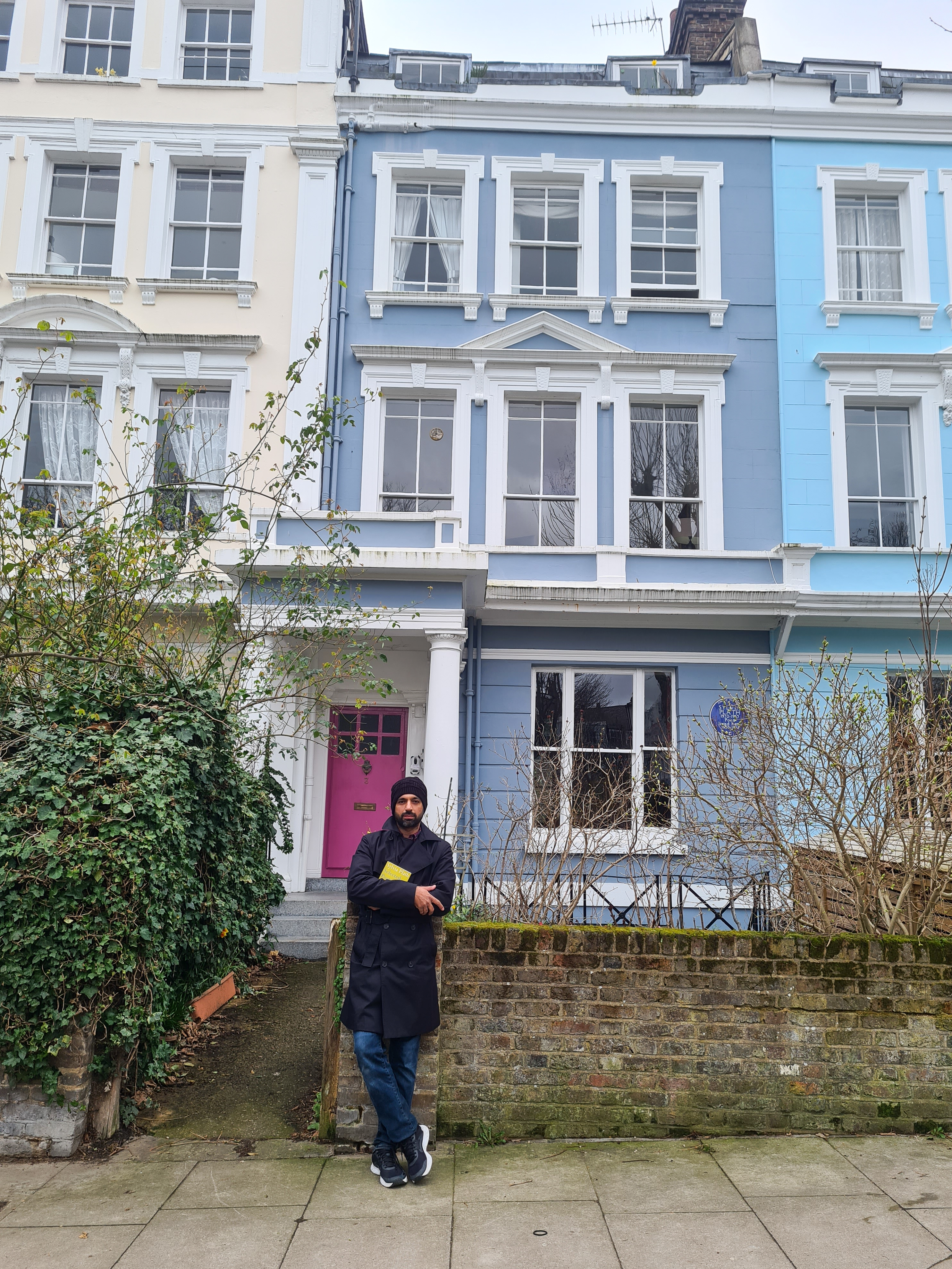
As I walk down Chalcot Road, flanked by the colourful townhouses of Primrose Hill, my heart is in rapture. Somewhere on this lane is my destination. A place I’ve seen so often in photographs that it has seeped into my dreams. Yet, I cannot pick it out of the lineup. Is it supposed to be the ‘substanceless blue’ of a dawn sky? Or the ‘too red’ of tulips? I forget. I fret. I fail to consider the possibility of repaint. A lively garden sprouts on the right, all too green. Facing it is a slate-blue three-storey house with a violently magenta door. It is unremarkable on this rainbow street, except for a ceramic blue plaque that whispers, “Sylvia Plath (1932-1963) Poet lived here (1960-1961)”.
The English Heritage plaque adorns the facade of 3, Chalcot Square. This townhouse’s top-floor apartment was the residence of Plath and her husband, Ted Hughes, from January 1961 to August 1962. Plath was prolific in this period, writing her only novel, The Bell Jar, and publishing her first poetry book, The Colossus. The house stands in stark contrast to another address nearby—23, Fitzroy Road—where Plath ended her life in February 1963. She was drawn there by another blue plaque, which bears the name of W.B. Yeats (1865-1939). I will visit Yeats’s house too, but its darkness will obscure its details from memory.
Visiting Plath’s home may be my personal pilgrimage, but it is part of a bigger journey. My wife and I have embarked on a tour of three UK cities—London, Edinburgh, and Bath. Timed to blunt the sting of my 35th birthday, the trip also marks a rebirth—for me, a leap of faith from a full-time job to a pursuit of literary dreams; for her, the conception of a children’s book. Naturally, we seek fonts of inspiration.
Within spitting distance of our London apartment is an iconic address that calls out to both of us. The Sherlock Holmes Museum squats ostentatiously at 221B Baker Street. The four-storey Georgian townhouse, dating back to 1815, functioned as a lodging house before undergoing a themed makeover.
A guide donning a black Inverness coat takes us through the quarters with a narrative that indulges our sense of whimsy. The house is filled with Victorian antiques that befit its adopted moniker and personality of a museum. Sample the living room: two sofa chairs for meeting clients, a magnifying glass alongside two hats, a violin with a Beethoven book, a fireplace mantel, an assortment of pipes, an ornate wallpaper riddled with bullet holes that spell out V.R. (Victoria Regina), a bookshelf groaning under rows of leather-bound books, a chemistry lab, and a July 1881 edition of The Times sprawled open on a study desk. It might as well be a functional detective den, except most of the items are weathered, clinging to a memory of gas lamps and cheap tobacco.
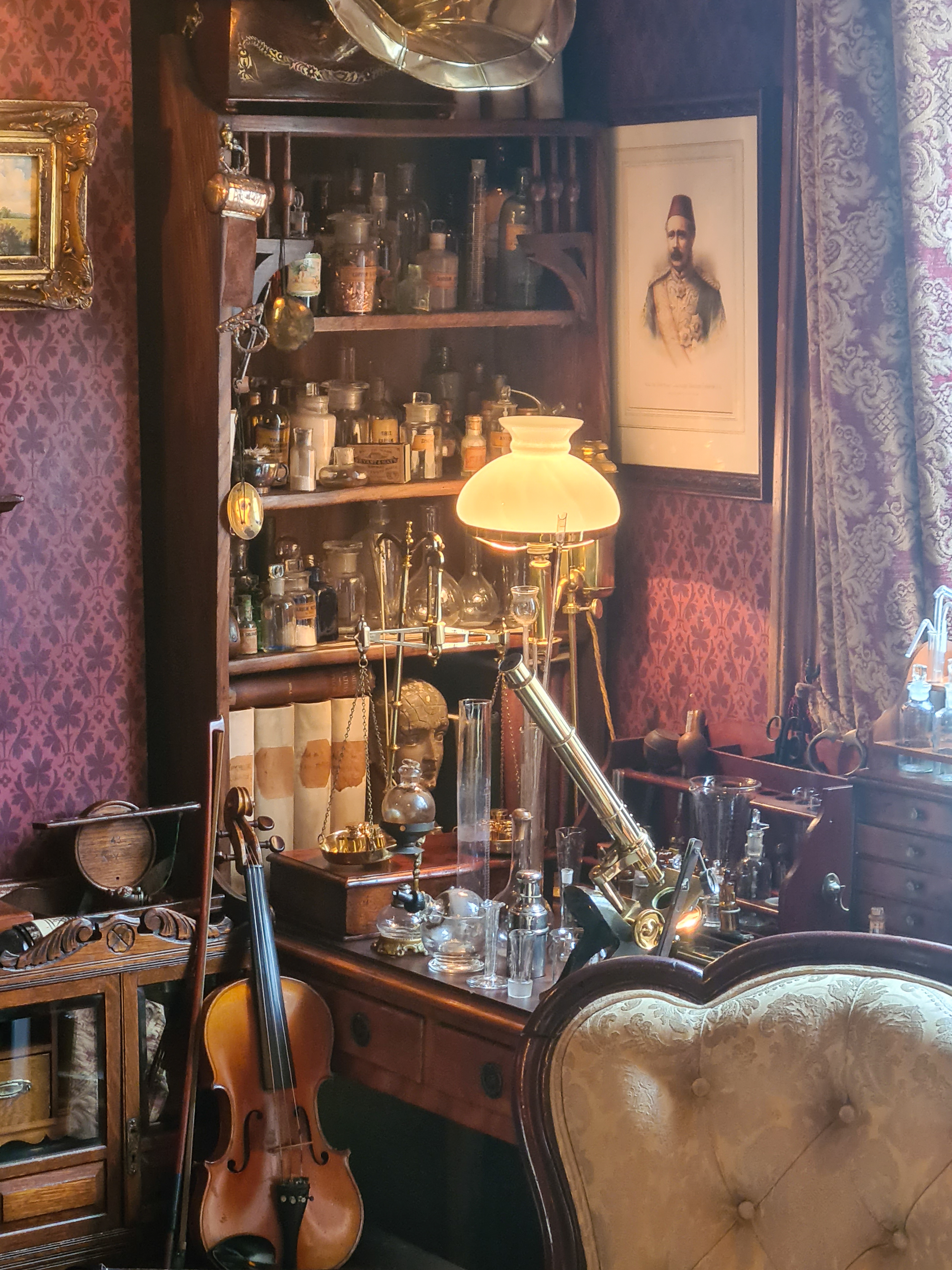
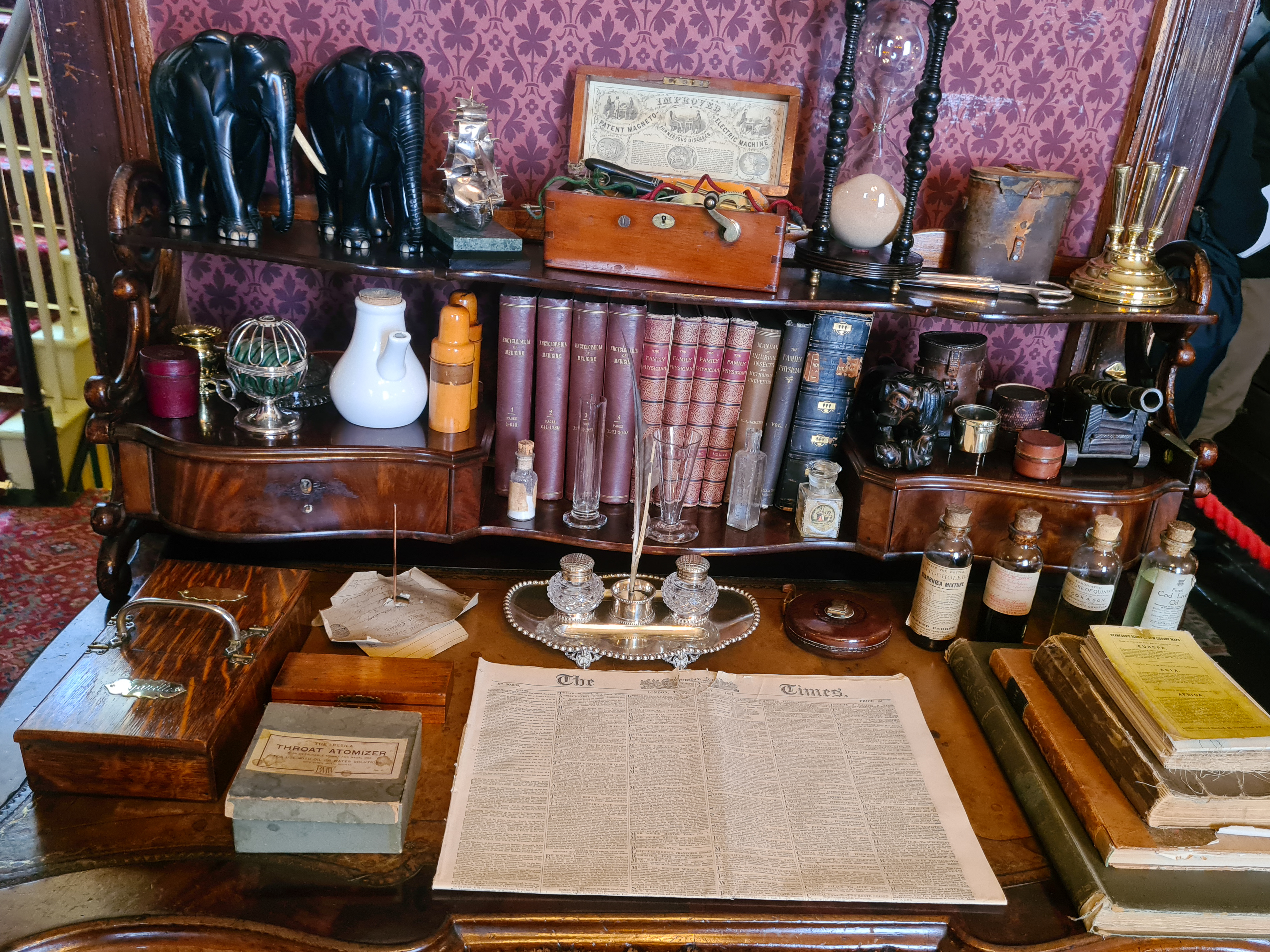
Mrs Hudson’s room upstairs holds artefacts from famous cases: a mask and gloves belonging to Lucy Hebron from The Yellow Face, a Napoleon bust from The Six Napoleons, a Bible concealing a revolver from The Solitary Cyclist, etc. Wax dummies stand frozen in key story moments, a gimmicky act that breaks the spell of time travel. As a writer I’m dismayed by the lack of limelight on the myth’s creator, Sir Arthur Conan Doyle. But the queue outside the doors reaffirms the timelessness of his stories.
While poetry is my church, my partner’s house of worship lies in Edinburgh. This is where J.K. Rowling wrote a large chunk of the Harry Potter series, sheltering in the warmth of cafes at first and later, as fame and riches found her, basking in the luxury of The Balmoral. Itching to trace her footsteps, we sign up for a pay-what-you-like walking tour. Our guide, Colin Bramwell of The Potter Trail, arrives in a flowing black robe and whisks us off to a graveyard. Greyfriars Kirkyard reminds me of the cemetery in Little Hangleton. This is for a good reason, apparently. Bramwell reveals that Rowling often strolled in this graveyard to gather her thoughts—and she got more than quietude out of the exercise. He points out gravestones with familiar names: McGonagall, Moodie, and even a Thomas Riddell.
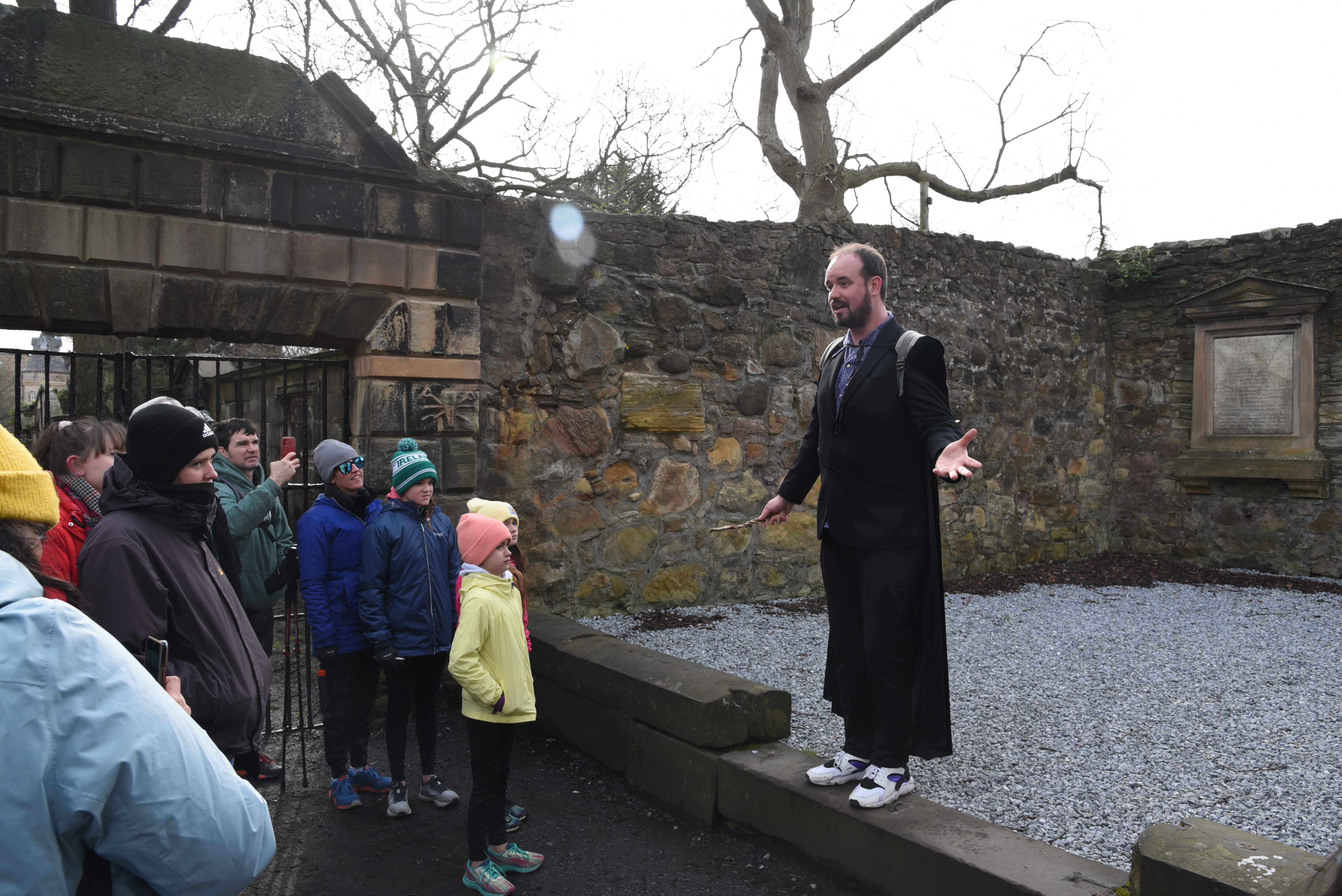
It’s an ingenious way to solve an old writer’s problem: How to come up with memorable character names? But the fictional characters’ popularity has led to a peculiar problem: fans queuing up to take selfies with gravestones of strangers. I suspect the kin of those resting here may not look too kindly upon Rowling today. After all, every person buried in this graveyard led a rich life worth remembering. For instance, William McGonagall, Bramwell informs us, is “widely regarded as the worst poet in the world.” Look up some of his doggerel verses, and you understand why.
Sharing a wall with the graveyard is a turreted 17th-century building made in the Scots Renaissance style. Unsurprisingly, it’s a school that divides students into four houses. Bramwell, too, sorts our group into four and peppers the walk with trivia questions for an imaginary House Cup. We swish and flick our wands with new incantations like Rossio Lumos, which turns traffic lights green. “The timing is critical for this spell,” quips our instructor. A writer himself, Bramwell narrates Rowling’s life in the Scottish capital with unveiled admiration and comedic flair. We walk past two of the author’s favourite writing haunts—a cafe since replaced by a Chinese restaurant and The Elephant House, which is shut temporarily for repairs. The stroll ends in Victoria Street, which claims to be the inspiration behind Diagon Alley. Not only is it a diagonal cobblestoned alley, but its colourful shopfronts also evoke visions of magical stores. The most prominent one holds a blue plaque dedicated to ‘Robert Cresser’s Brush Shop’. Founded in 1873, it sold Victorian boxes and broomsticks for 131 years and is speculated to be the inspiration behind Ollivander’s. Today, it is the flagship Museum Context store, which sells Harry Potter merchandise.
Art imitates life imitates art.
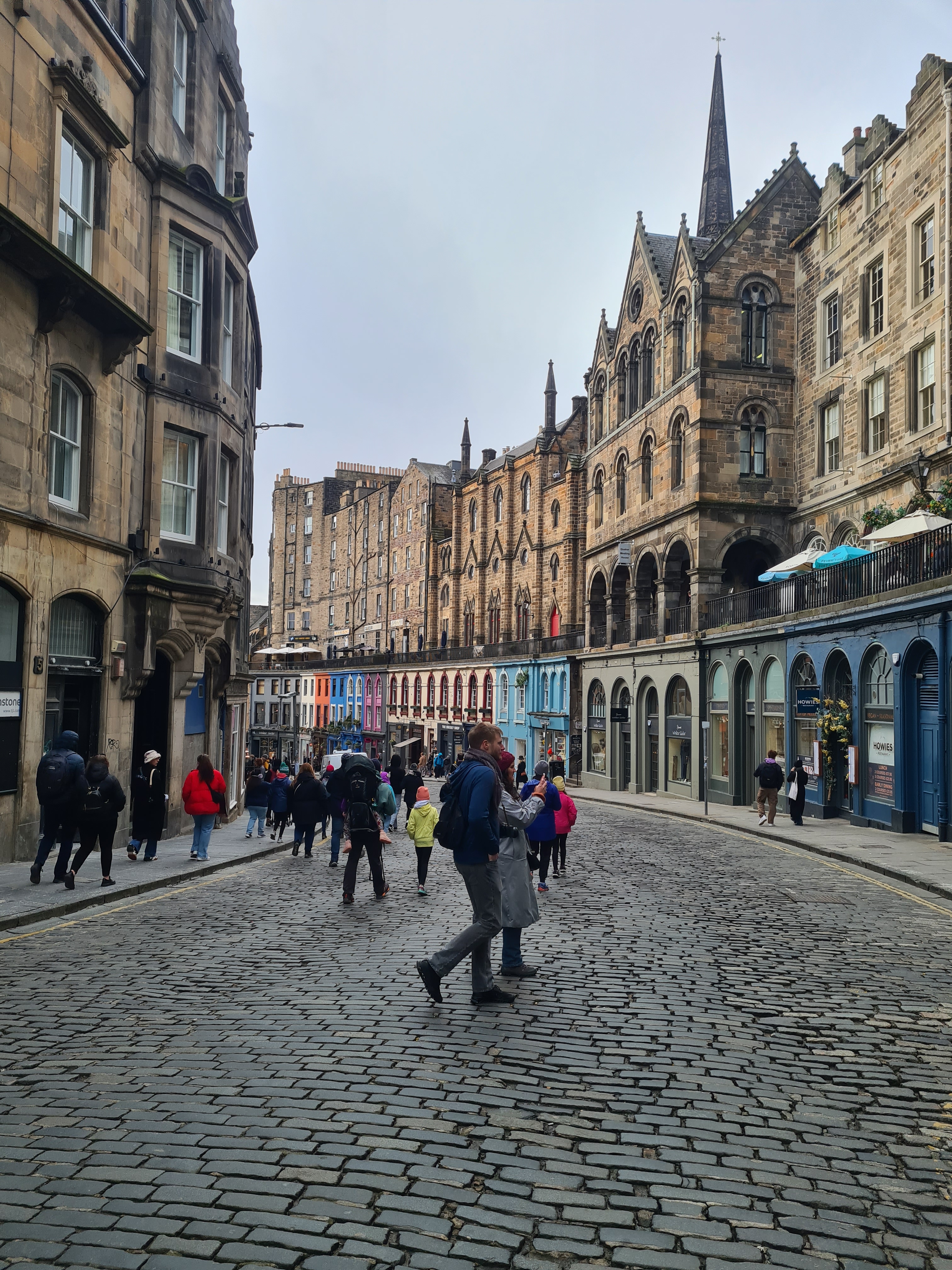
to be the inspiration behind Diagon Alley.
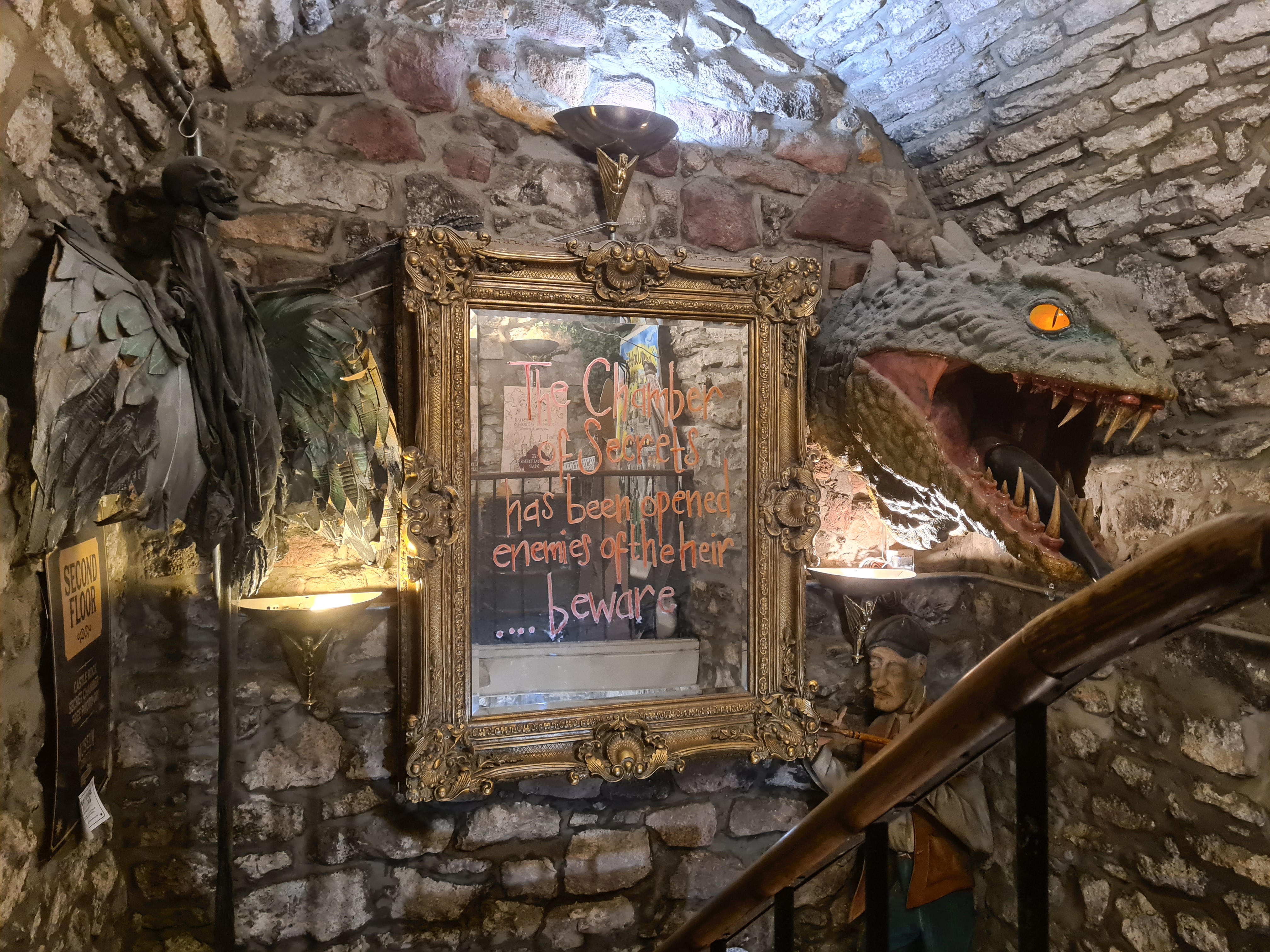
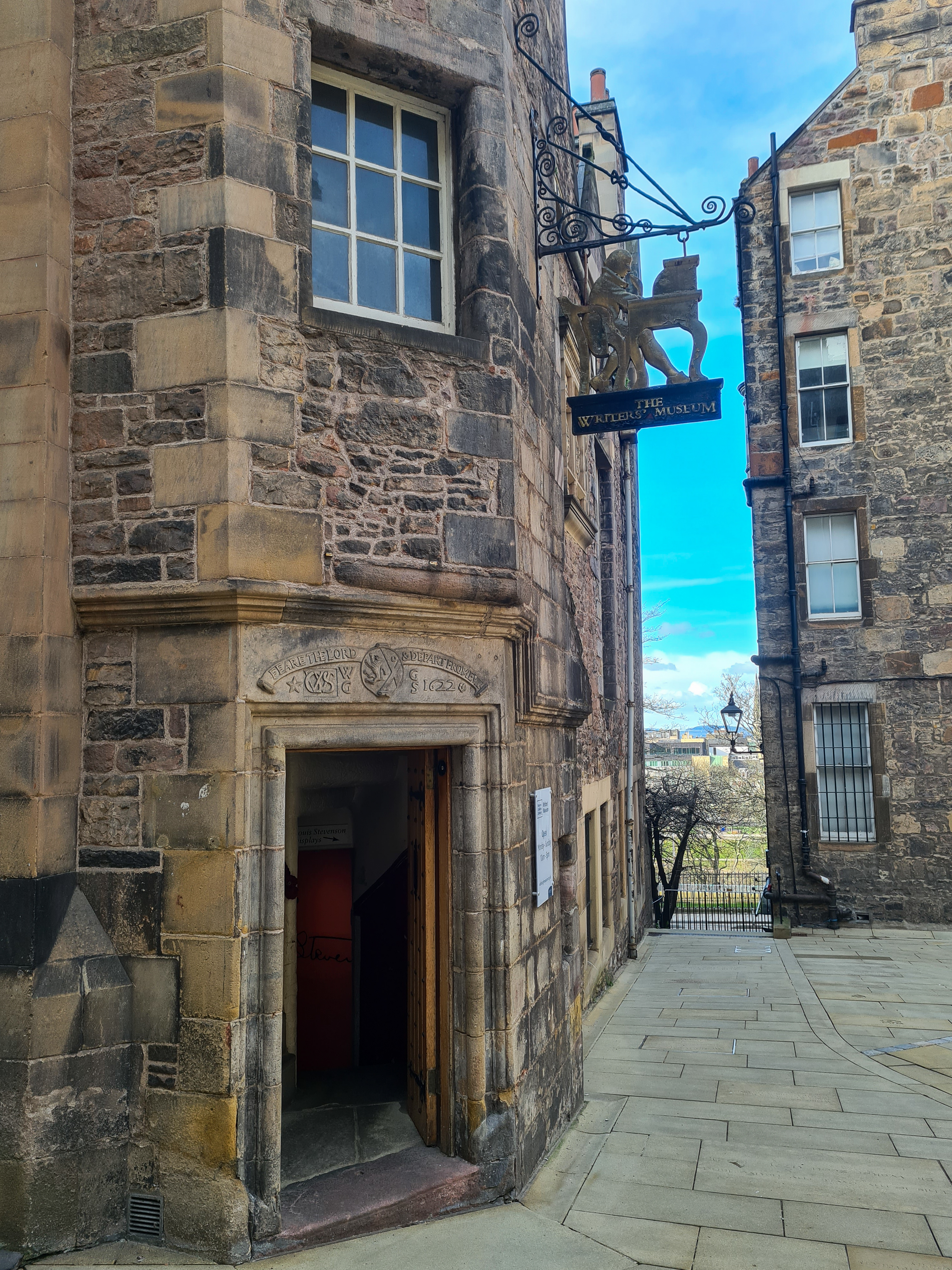
Harry Potter is akin to a potion of liquid luck for businesses in Edinburgh, but it’s hardly the only literature of note to come out of it. To go further back in time, we pay a visit to The Writers’ Museum. Housed in a 17th-century townhouse called Lady Stair’s House, it is a free museum run by the Edinburgh City Council that celebrates three Scottish greats—Robert Burns, Sir Walter Scott, and Robert Louis Stevenson (RLS).
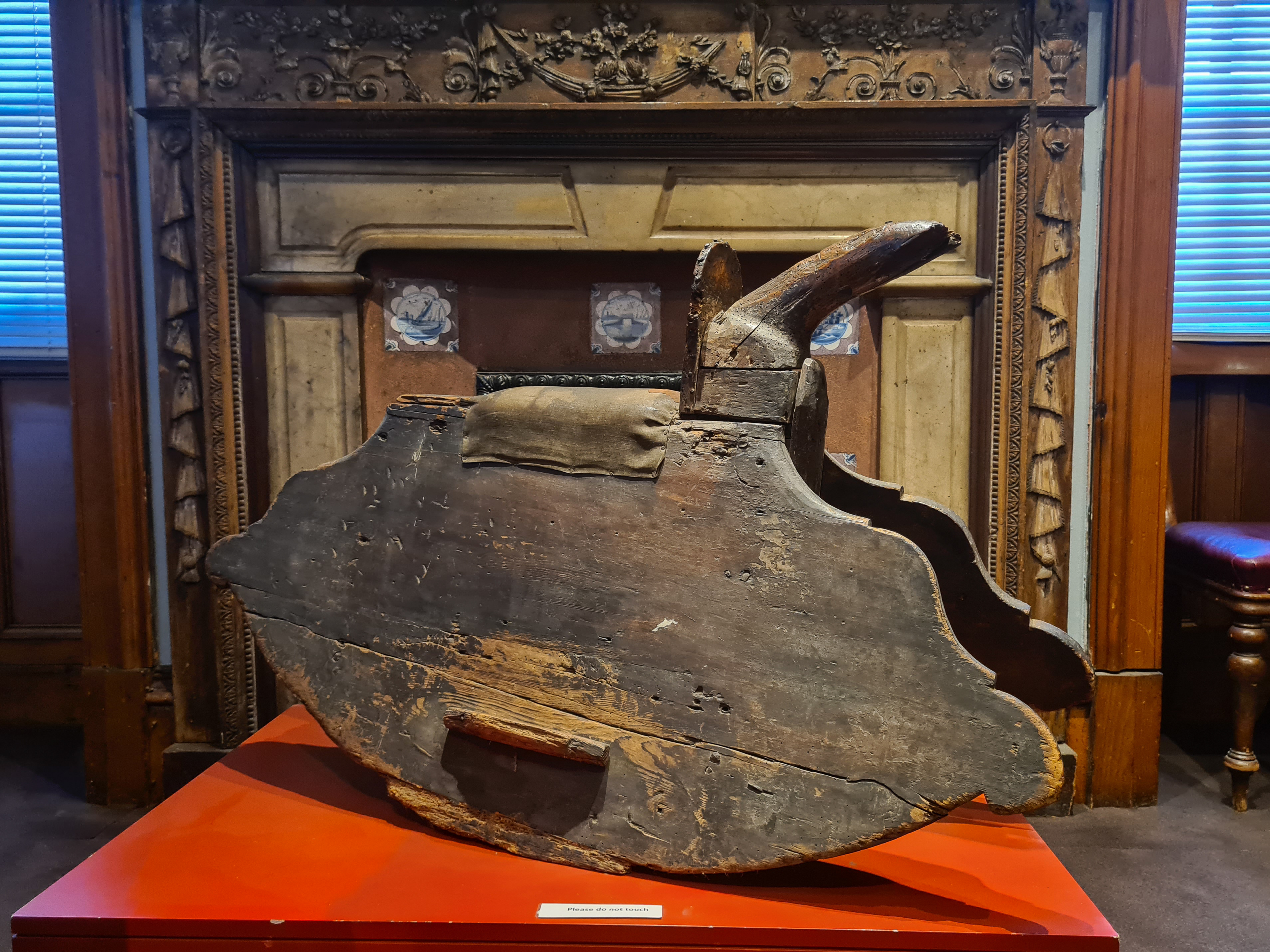
The museum holds a remarkable collection of personal objects, photographs, and rare editions. There are textured antiques like Burns’s writing desk, a child’s rocking horse modified to suit Scott’s lameness (possibly caused by polio), and a printing press on which the Waverly novels were produced. And then there are some peculiar artefacts, like a plaster cast of Burns’s skull and a lock of RLS’s hair! A draft of Burns’s song Scots Wha Hae and first editions of Waverly and A Child’s Garden of Verses hold me in thrall. The house itself retains its old-world idiosyncrasies, like steps of varying height on a spiral staircase designed to trip burglars.
Just outside the museum is Makars’ Court, a public square that doubles as an evolving literary monument. It is speckled with flagstones inscribed with the names and words of Scottish writers spanning six centuries.
The third city on our itinerary traces its literary history to the Regency era. Bath was home to Jane Austen for five years. She moved to the spa town with her family, albeit reluctantly, in 1801. Things got worse in 1805 when Austen’s father died. But the author wrote through her grief and financial struggles, and Bath’s society offered itself as a dramatic setting for novels like Northanger Abbey and Persuasion.
At the Jane Austen Centre, a guide clad in full Regency regalia takes us through the writer’s tumultuous life with some visual aids and silly theatrics (think ghosts knocking on walls). We get a glimpse of Austen’s familial relationships, the inspirations behind her work, and a blurry image of her physical features. This is because there exists no definitive portrait. What we have is an incomplete jigsaw: a half-finished sketch made by her sister Cassandra that was said to be “horrendous” (hence, never completed); a portrait published in a memoir that tried to fill the gaps in the first one; a sketch of her back; a silhouette titled Amiable Jane that is contested by experts due to its incongruence with Austen’s height and contours; a painting titled Jane that experts have debunked citing anachronistic clothing (it might depict her niece, also named Jane); and a modern portrait drawn by a forensic artist who drew from historical eyewitness accounts. It is this last likeness of Austen, and stories of her writerly grit, that we take with us as souvenirs from Bath.
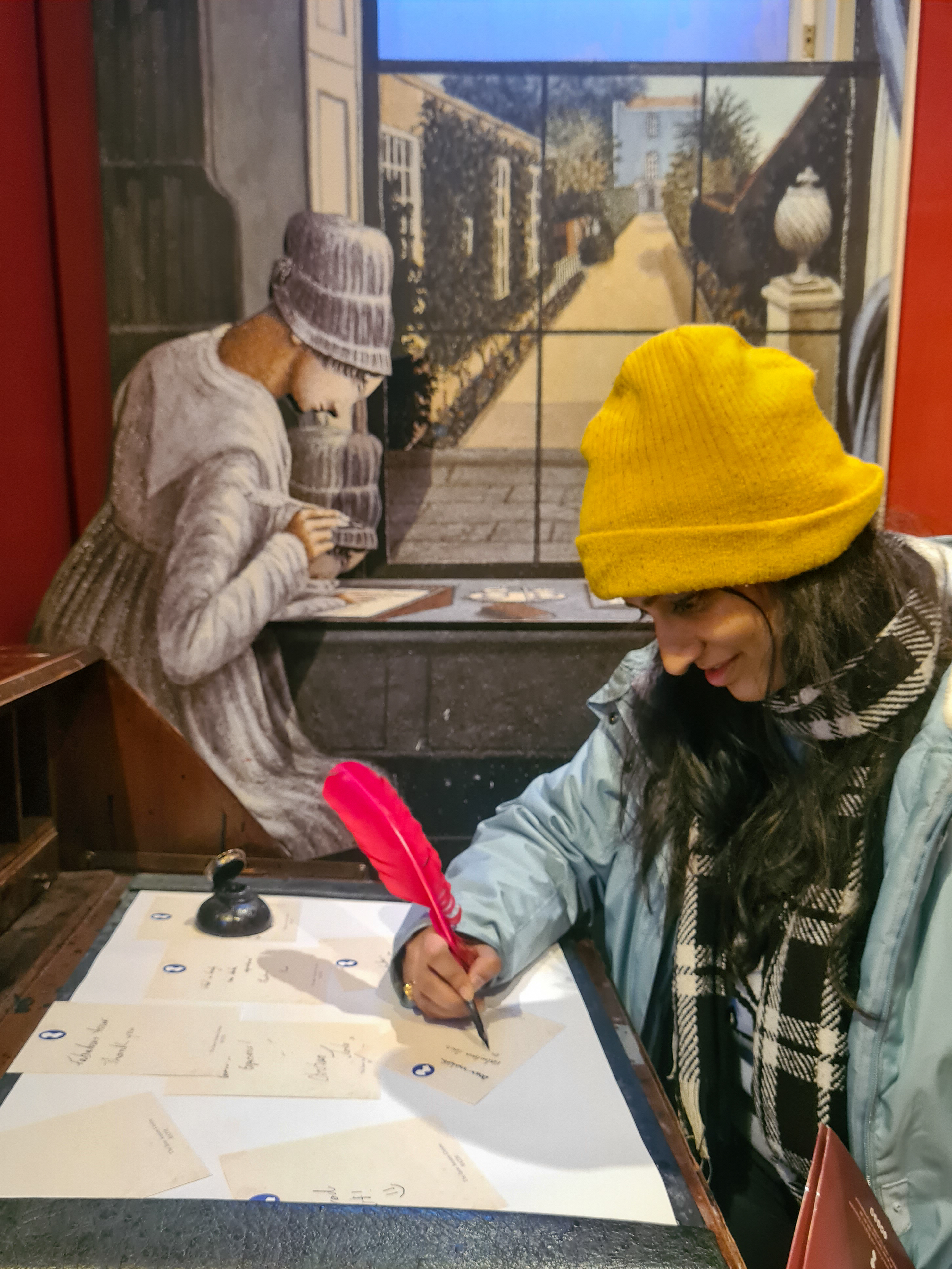
Jane Austen Centre in Bath.
Back in London, we end the trip by paying our respects to some masters. Opened in 1839, Highgate Cemetery is the final resting place of 1,70,000 people today. Divided into an East and a West side, the garden cemetery holds a total of 53,000 graves amidst towering trees, shrubs, and flowers. A walk in this garden cemetery is serene but sobering.
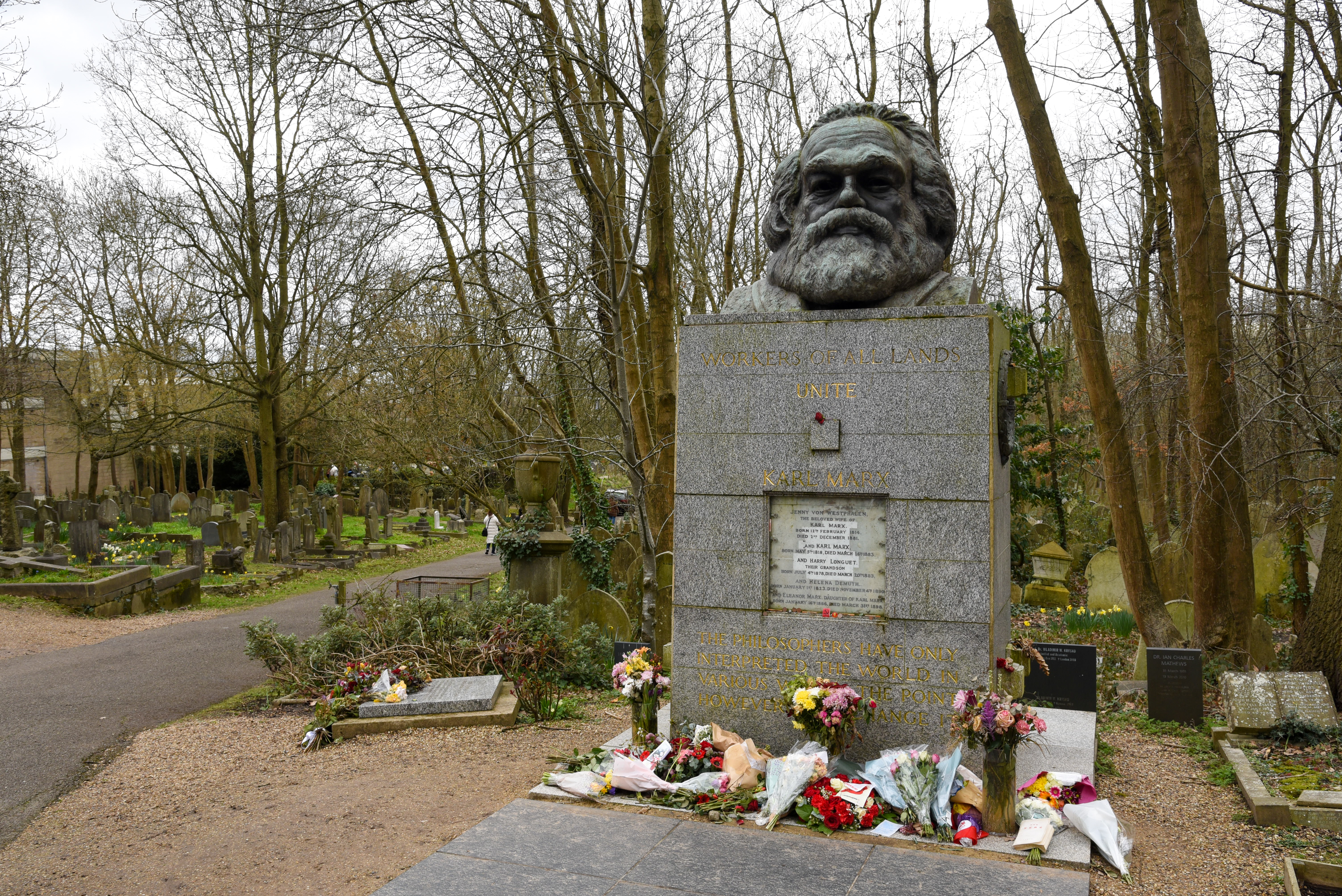
On the East side, Karl Marx’s grave is impossible to miss—a sculpture of his heavily bearded face sits atop a tall tombstone. The grave is generously decorated with bouquets, pamphlets, and messages. The stone is engraved with a rallying cry from The Communist Manifesto: “Workers of all lands, unite.” But it is the other, longer engraving that holds my gaze: “The philosophers have only interpreted the world in various ways. The point, however, is to change it.”
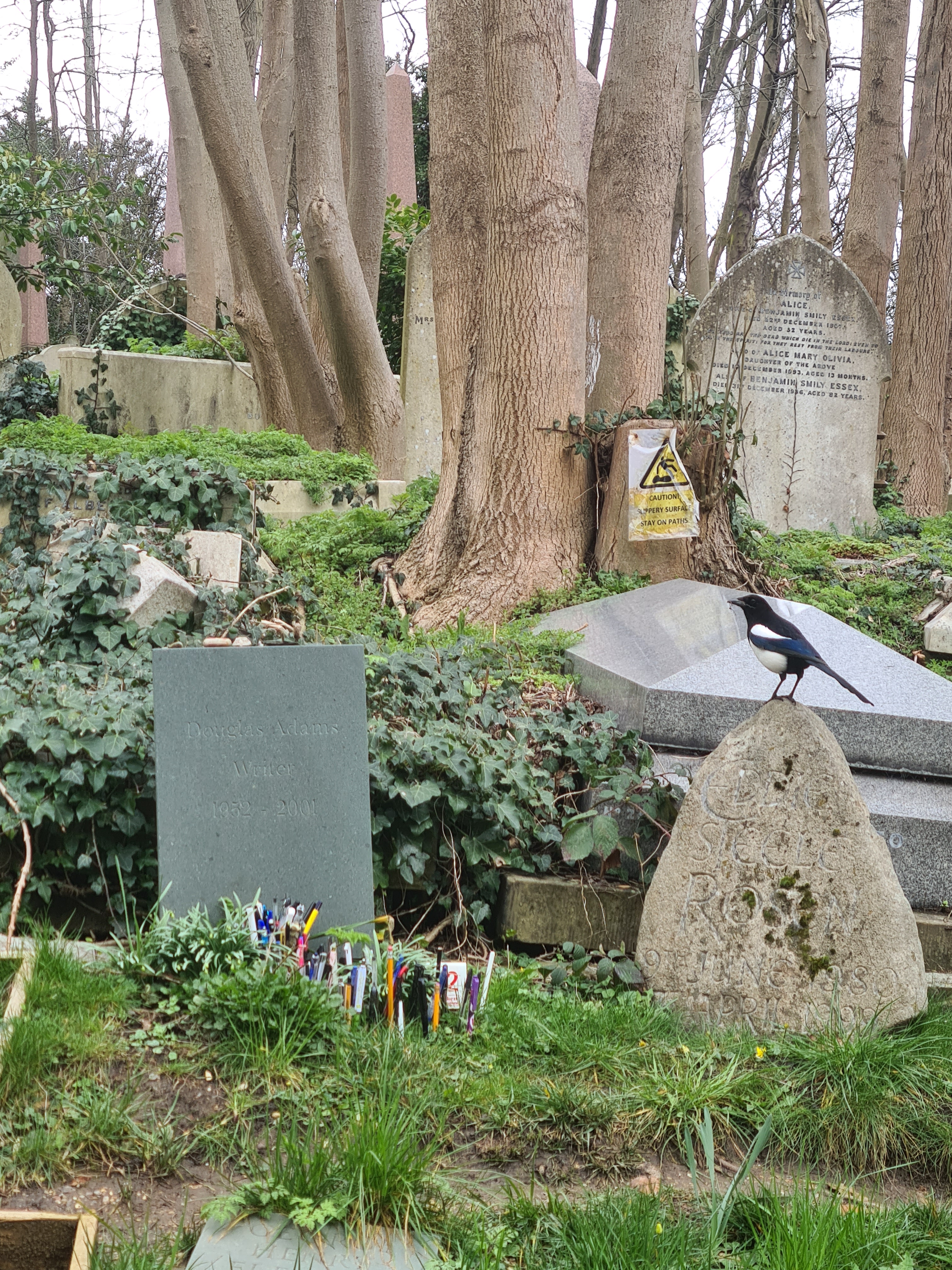
In comparison, Douglas Adams’s grave is nondescript, with its small grey tombstone and soft engraving. It’s given away by dozens of pens and pencils sticking out of the ground, tributes to the groundbreaking writer. Around the corner, ample flowers have burst forth from the grave of Mary Ann Evans, better known by her pen name George Eliot. The English novelist and poet has a tall obelisk for a tombstone.
Like many others, poet Christina Rossetti rests in a family grave. But theirs has an unsettling history. Rossetti’s sister-in-law, Elizabeth ‘Lizzie’ Siddal, started out as a model for painters of the Pre-Raphaelite Brotherhood—she famously sat for John Everett Millais’s Ophelia—and later became an artist herself. When Lizzie died at 32 of an opiate overdose, her grief-stricken husband, Dante Gabriel Rossetti, buried his poems with her body. A few years later, he was coaxed into exhuming and publishing these verses—a decision that haunted him for the rest of his life.
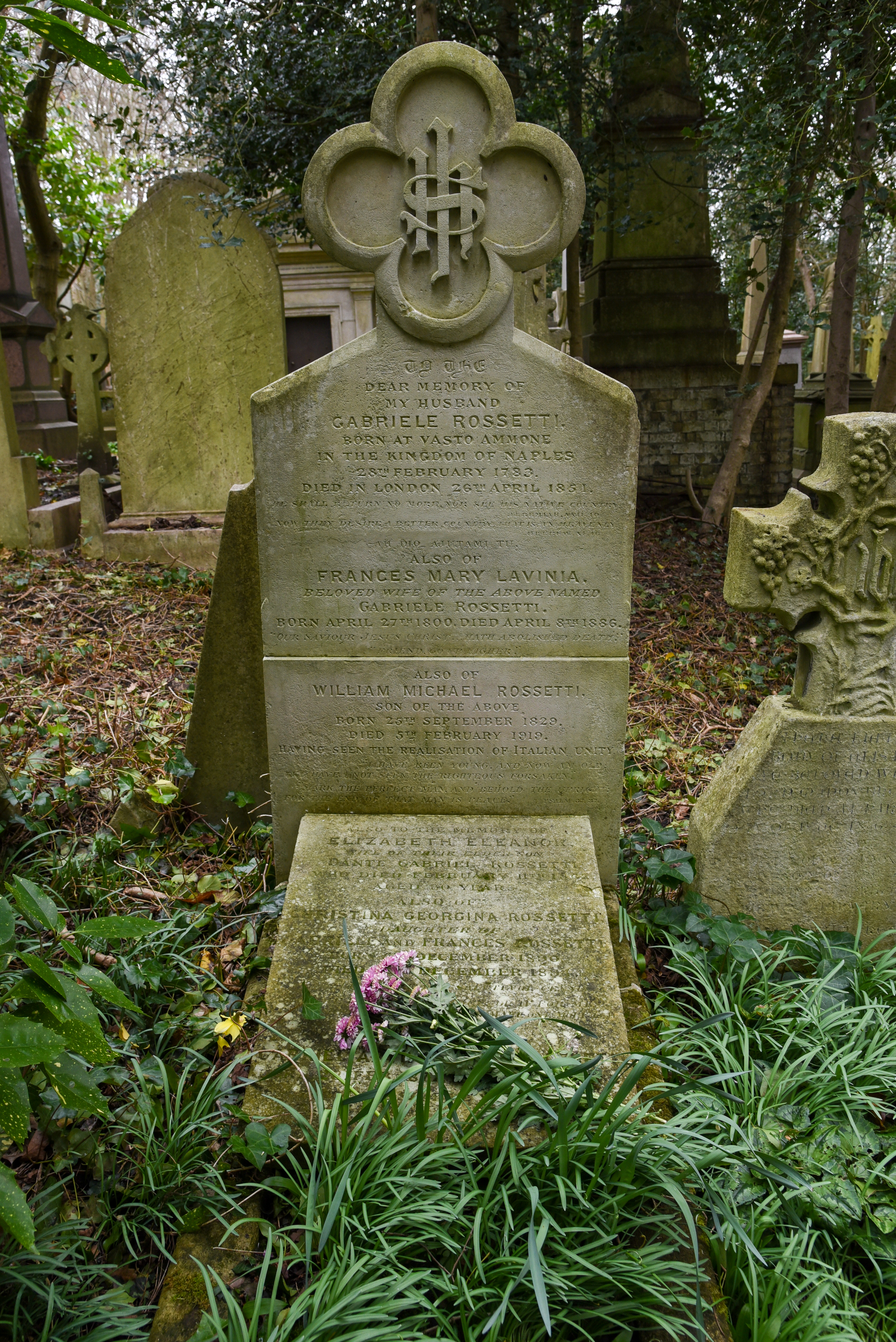
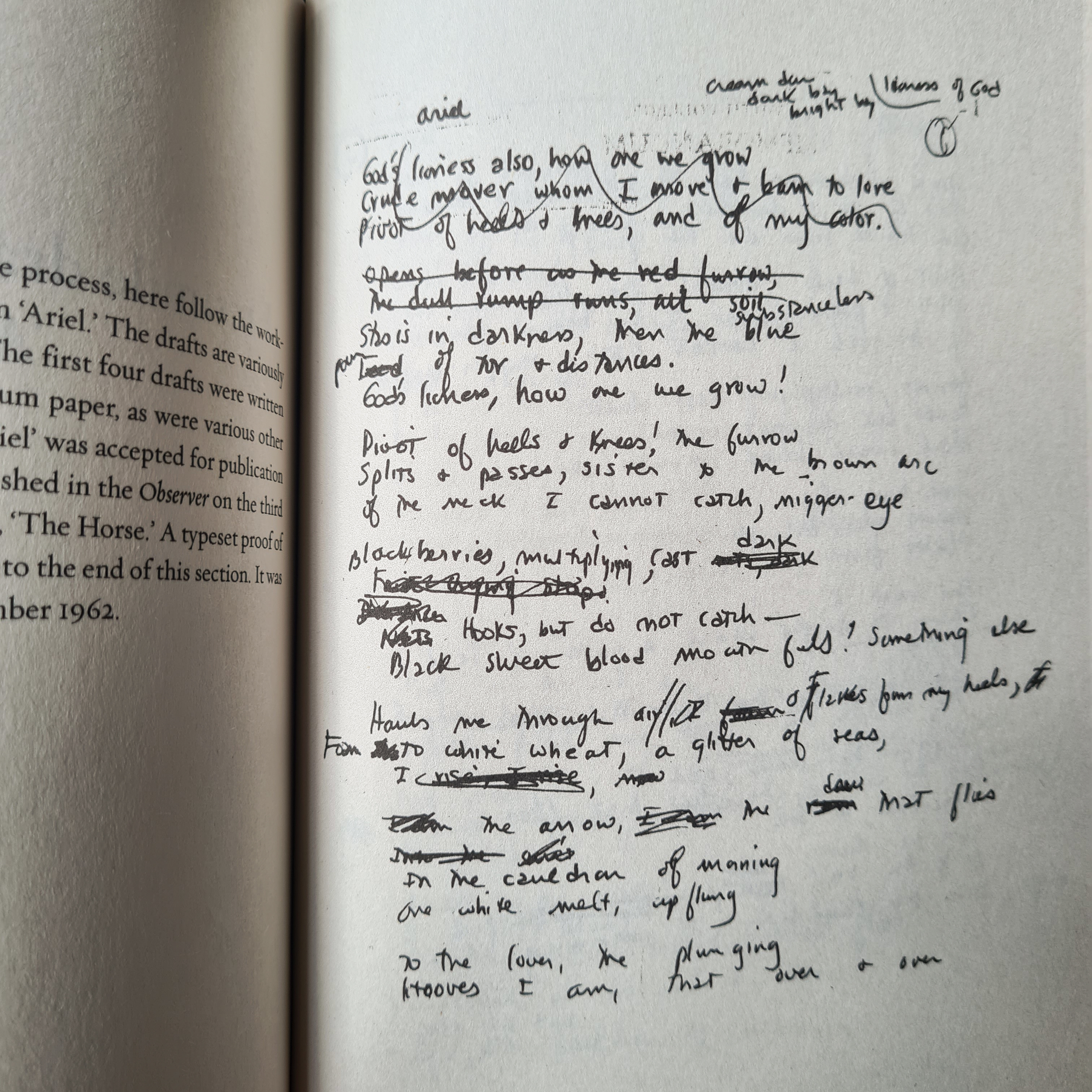
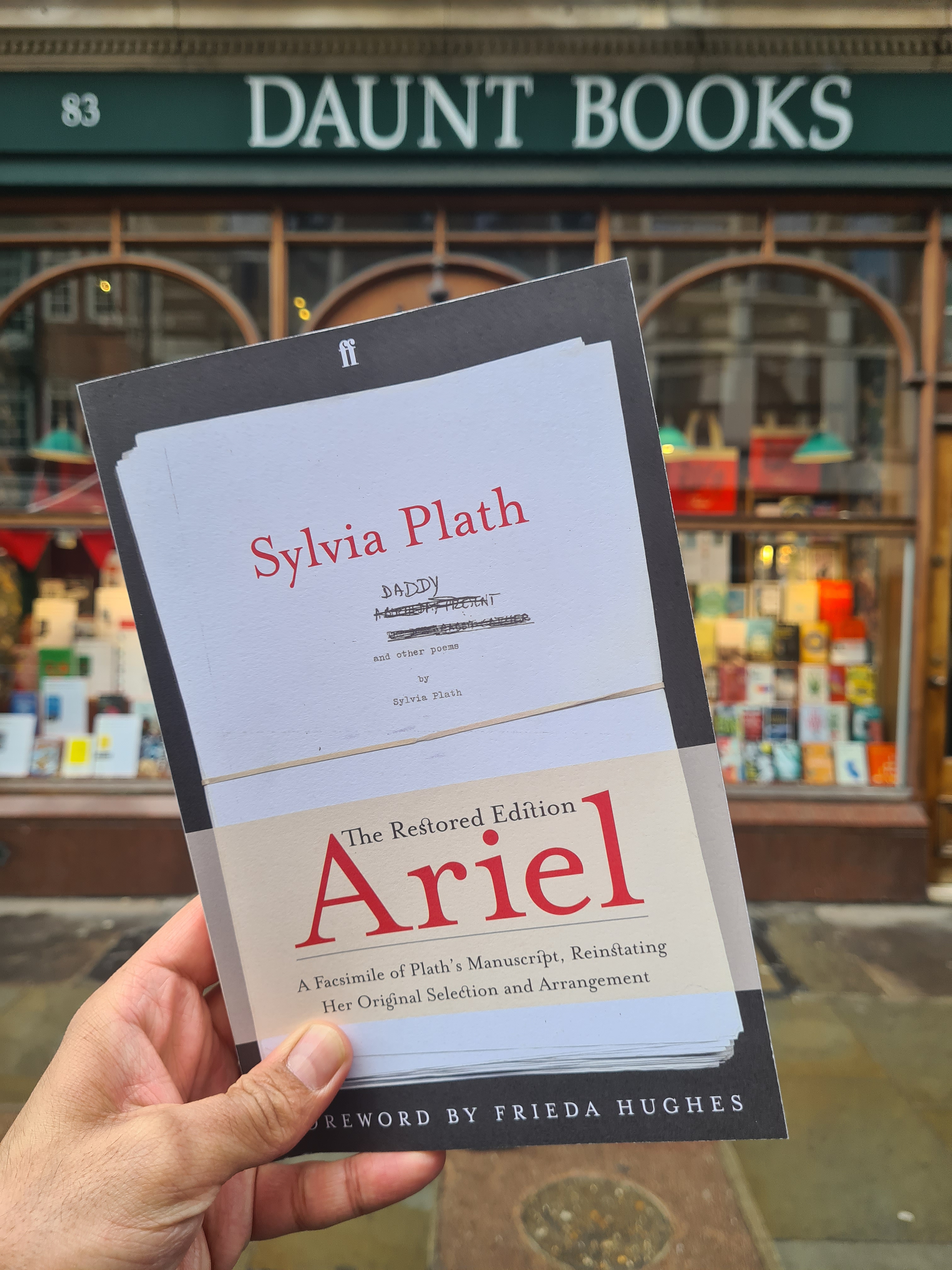
As I exit the Rossetti Path at Highgate Cemetery, I realise there is one important name missing from my tributes. Sylvia Plath was laid to rest in a churchyard in Heptonstall, West Yorkshire—a place so out of our way it warrants another trip. So, instead of flowers or pens for her grave, I pick up the one thing Plath left behind on her desk. Published posthumously, Ariel was Plath’s swan song but the book was moulded by Hughes’s hands. Daunt Books Marylebone (dauntbooks.co.uk), a quaint Edwardian bookshop, is kind enough to procure a copy of Ariel: The Restored Edition, which holds a facsimile of Plath’s original manuscript, scribbles and all.
When I stand in front of her home at Primrose Hill, I do not knock on the magenta door. This is no museum. There are no tours back in time. Leaning on the red-brick altar, I invoke her verse, “Love set you going like a fat gold watch…” A dog-walker pauses to listen. Someone peeks out of the highest window. The door throbs in place, the colour of an old wound.
PLAN YOUR TRIP
Getting There
Many airlines fly from Delhi and Mumbai to London. Air India (airindia.com) and Vistara (airvistara.com) are among those that run non-stop flights. Trains run by the London North Eastern Railway (lner.co.uk) take you from King’s Cross to Edinburgh in 4.5 hours. Buses take eight hours, and there are up to five departures every day on megabus (uk.megabus.com).
Where to Stay
London: Set in a restored Edwardian mansion near Covent Garden, Rosewood London (rosewoodhotels.com) takes you back to the belle epoque. Equally luxurious but opposite in style, Shangri-La The Shard (shangri-la.com) occupies 18 floors (34-52) of Western Europe’s tallest building. For a stay soaked in history, check into Brown’s Hotel (roccofortehotels.com). Since 1837, it has played host to literary giants like Mark Twain, Rudyard Kipling, James Faulkner, Joseph Conrad, Jorge Luis Borges, JRR Tolkien, and many more.
Edinburgh: We stayed in the classy and affordable ibis Styles Edinburgh St Andrew Square (all.accor.com). Located in the capital’s New Town, the hotel is at a walking distance from Calton Hill and the Scott Monument while also being close to museums and nightlife hotspots. Alternatively, you could experience the room in which the last Harry Potter book was finished at The Balmoral (roccofortehotels.com). It’s called the J.K. Rowling Suite and holds the marble bust of Hermes that the writer signed.
Things to Do
London
The Sherlock Holmes Museum is at 221B Baker Street. Open 9:30am-6pm, Mon-Sun; tickets £16 per adult, £11 per child (6-15); sherlock-holmes.co.uk
Highgate Cemetery has an East section and a West section. Guided tours are available only in the latter but entry to either entails an admission fee. Open every day 10am-5pm; Highlights Tour £15 per adult, £8 per child (includes entrance to both sides all day); highgatecemetery.org
You can visit Keats House, a Regency villa in Hampstead where the Romantic poet lived from December 1818 to September 1820 and wrote many poems. Open Wed, Thurs, Fri, and Sun, 11am-1pm and 2pm-5pm; £8.40 per adult; cityoflondon.gov.uk
Charles Dickens Museum is located at 48 Doughty Street, the London home of the author. Open Wed-Sun, 10am-5pm; £12.50 per adult, £7.50 per child (6-16); dickensmuseum.com
Dickens is one of over 100 writers and poets buried at Poets’ Corner, Westminster Abbey. Abbey entry ticket £27 per adult, £12 per child (6-17); westminster-abbey.org
Fans of The Bard can visit Shakespeare’s Birthplace and other family homes in Stratford-upon-Avon. Tickets from £20 per adult and £10 per child (3-15); shakespeare.org.uk
Edinburgh
The Potter Trail conducts free public tours (with optional donation) twice a day and paid private tours of Edinburgh with guides who are trained performers. pottertrail.com
The Writers’ Museum is located in Lady Stair’s Close, just off the Royal Mile. Open every day, 10 am – 5pm; entry free; edinburghmuseums.org.uk
Bath
The Jane Austen Centre is located in the heart of Bath and offers performative tours by actors. It’s famous for hosting the Jane Austen Festival, scheduled for September 8-17 this year. One-hour tours start at 9.50am and end at 4.20pm every day; tickets £14.75 per adult and £7.20 per child (6-16); janeausten.co.uk
 Sumeet Keswani
Leave a comment